Document every scratch with a condition report
Words like “excellent” or “some playwear” mean different things to different people. A condition report in GuitarHelp shows exactly where each mark is, what it is and how serious it is, on a drawing of your guitar’s body.
Mark issues on a diagram of your guitar
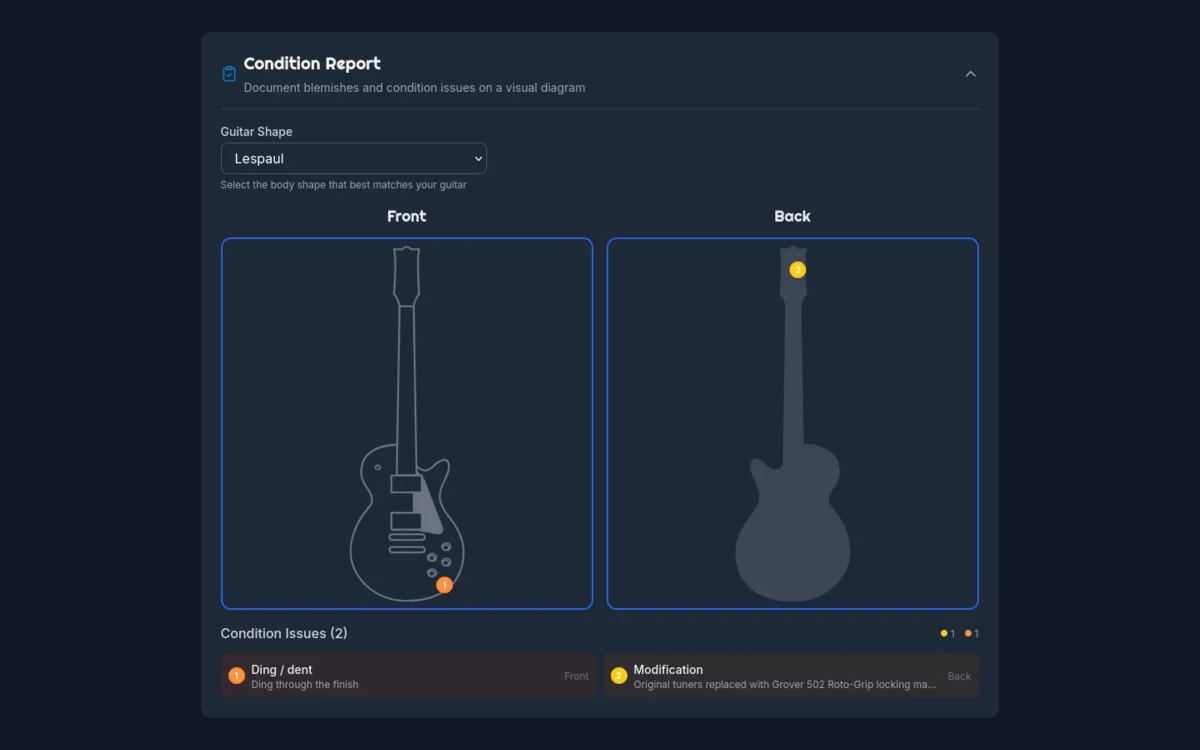
Pick the body shape closest to your guitar: Stratocaster, Telecaster, Les Paul, SG, semi-hollow, offset, superstrat, Explorer, Flying V or Rickenbacker style. Then click on the front or back of the drawing wherever there is something to record.
For each mark you choose:
- the type: scratch, ding or dent, chip, crack, wear, fret issue, hardware issue, electronics issue, repair, modification or other;
- the severity: minor, moderate or major;
- a note with the details.
A condition score from 0 to 100
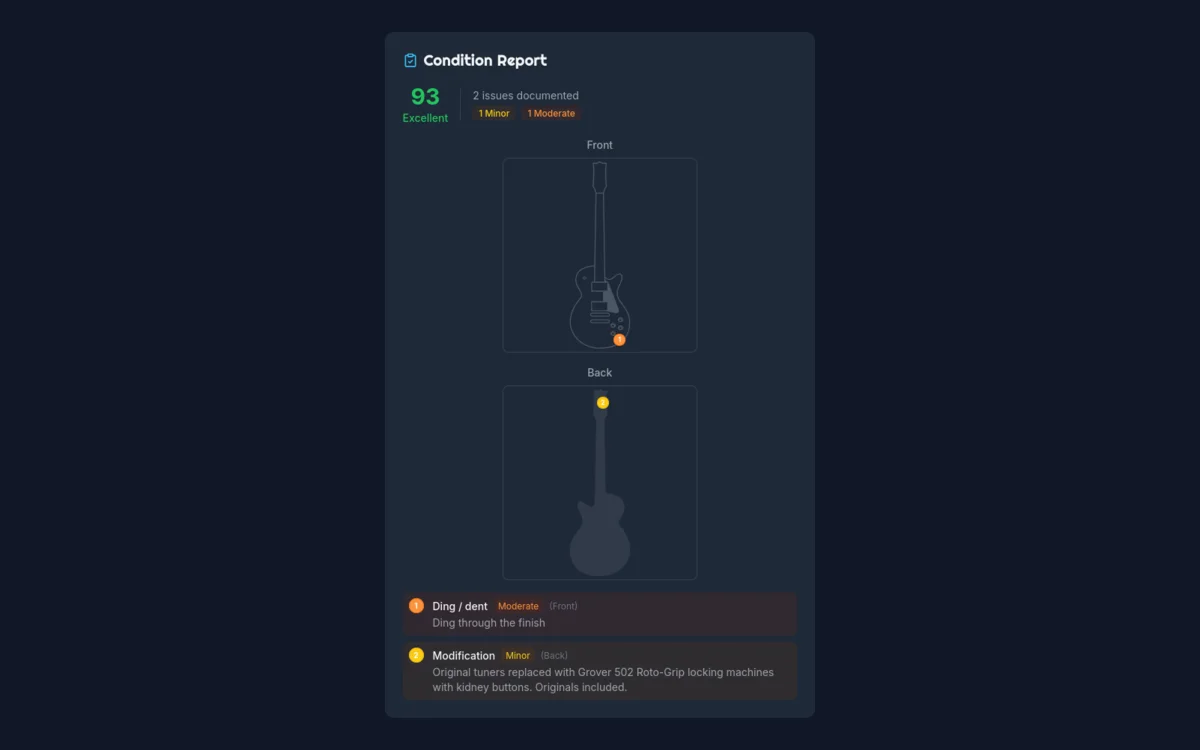
GuitarHelp turns the marks into a score: it starts at 100 and takes off 2 points for each minor issue, 5 for each moderate one and 10 for each major one. The score comes with a label, from Mint (95 and up) through Excellent (85+), Very Good (70+), Good (55+) and Fair (40+) to Poor (below 40). The report lists every issue grouped by severity, so the score is never a mystery.
Share it with a buyer, a tech or an insurer
When you create a share link for a guitar, you can include its condition report. The person you send it to sees the diagram with every marker and the list of issues, without an account. It is a quick way to show a buyer what they are getting, or to show a repair shop what needs attention.
Keep it current
Add a marker when something happens. Once it is fixed, remove the marker or add a repair marker in the same spot, so the history stays visible. Over time the report becomes a record of how the guitar has been looked after, which matters when you sell it or make a claim.
What a condition report is, and isn’t
A condition report records what you can see and what you know about the guitar. It isn’t a professional appraisal, and the score doesn’t set a price; it is a consistent way to describe wear so that you, a buyer or a repair shop are talking about the same marks.
- Photograph each marked area as well, and keep the photos with the guitar.
- Record the condition when the guitar arrives, then again after big changes like a refret.
- Use the note on each marker for the details a buyer would ask about, such as size or depth.
Try it with your own guitars
GuitarHelp is free and runs in your browser.
Start your collection